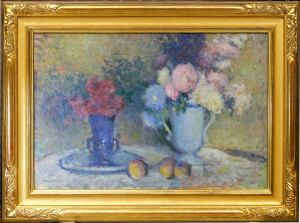
Edmund W. Greacen
(1876-1949)
Between 1905 and 1935 Edmund W. Greacen enjoyed an except-
ionally artistic and privileged life, and created many colorful
Impressionist works in oil on canvas and board.
Greacen was born in New York City, and after graduating from
New York University was sent by his shoe manufacturing father on
a shoe-selling world cruise, which prevented the young man from
enlisting to fight in the brief Spanish American War of 1898. When
he returned from Europe, Edmund Greacen decided to pursue the
career of an artist and he enrolled in the William M. Chase School
of Art. Petite Ethol Booth of New Haven, Connecticut, caught his
eye, while she was studying in the immediate area, and they were
married in 1904. Ethol became the primary model for his en plein
air paintings, and together they traveled with Chase and fellow
students to Spain, and then the newlyweds went on to visit Holland,
Belgium, and England.
Mr. and Mrs. Greacen fell in love with Paris, but for two years
were charmed by the little country village of Giverney, and they
rented a maison near the garden estate of Oscar Claude Monet
(1840-1926), who is regarded as the high priest of French Impress-
onism. Although he only met the aged painter on one occasion,
Greacen was impressed with the cigarette-smoking, fully-bearded
artist and the avant garde water lily paintings he was creating in his
famous garden.
Back in New York City in 1909 with the first of their two child-
ren, Edmund Greacen began exhibiting his French oils at art shows
and galleries. He joined the National Arts Club and started The
Manhattan School of Art with another artist. It seems that Greacen
was following in the painterly footsteps of William Merritt Chase,
who was an influential art teacher and successful painter at the
same time.
Between 1910 and 1917 many American Impressionist artists
found their way to the stately and convivial home of “Miss
Florence” Griswold in Old Lyme, Connecticut. There the Greacens
enjoyed the camararderie, and Edmund, always the gentlemanly
person and artist, began to evolve his dappled and free-brush style
depicting landscapes and flower gardens.
After a six-month period with the French Y.M.C.A. during World
War I (because he was to old to serve in combat), Greacen again re-
turned to Manhattan where he was elected an Associate Member,
and later in 1935, an Academician in the National Academy of
Design. A one-man show at the notable Macbeth Gallery in 1922
preceded a $1,000.00 prize awarded to him by the prestigious
Salmagundi Club.
In 1924 Edmund Greacen began another art school, The Grand
Central School of Art in New York, which he operated for twenty
years, when a series of twelve strokes over the period of the same
number of years severly limited his talent and energy. After living
on Florida’s Gulf Coast for some years, the Greacens returned to
New York where he died at White Plains at seventy-three.