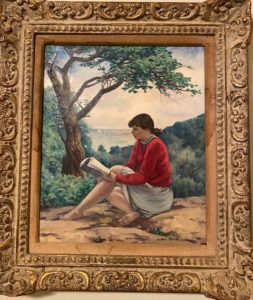
Leon Kroll
(1884-1974)
In 1927, at the age of forty-three Leon Kroll was fortunate to meet Marc Chagall, Aristide Maillol, and Henri Matisse while traveling in France with the French artist, Robert Delaunay. However, it was another famous French artist, Paul Cezanne, who most influenced his verdant and craggy landscapes of Rockport.
Born in New York City, Abraham Leon Kroll studied at the Art Students League, with Ohio-born John H. Twachtman, and in 1903, while attending the National Academy of Design, Kroll was awarded a scholarship to study painting in Europe. When his painting of a female nude won a Grand Prix prize in Paris in 1908, Leon Kroll began a career of winning major prizes in America, and portraying sensuous nude or semi-nude women in naturalistic settings, especially in and around the several stone quarry pools in Rockport.
Leon Kroll discovered Gloucester in 1912, and was always delighted to return to Cape Ann during the summer months, where he and his Parisian wife, Genevieve-Marie, lived in Folly Cove. They were neighbors of Folly Cove designers and textile print- makers, Virginia Lee Burton and her sculptor husband, George Demetrios, and other sculptors, Paul Manship and Walter Hancock. At the age of ninety, Kroll died in Gloucester, and he was buried in the Locust Grove Cemetery in Rockport.
The painting of murals in Washington, D.C., Worcester, Massachusetts, the Indiana State Capitol, and the Omaha Beach Memorial mosaic, highlighted Kroll’s talent in a large way, and on another level, he taught at the Chicago Art Institute and the Art Students League.
Three major awards he received in 1930 were the National Arts Club Maida Gregg Memorial Prize, the Pennsylvania Academy of Fine Arts Beck Gold Medal, and the Indianapolis Art Institute Purchase Prize. Kroll’s work is included in the collections of the Metropolitan Museum of Art, the Whitney Museum, the Chicago Art Institute, the Baltimore Museum of Art, the Corcoran Gallery of Art, and the Pennsylvania Academy of Fine Arts.
Leon Kroll was a colleague of ‘Ash Can’ artists George Bellows, William Glackens, and Robert Henri, but his contribution to modern American art veered away from their dark, gritty city views to a brighter, more colorful pastoral view, peopled with handsome men and women whose poses relate to the classicism of the past.